A reported Chinese floating structure in Bajo de Masinloc, also known as Scarborough Shoal, has again raised tensions in the West Philippine Sea. For Manila, the issue is not just the size of the platform, but what it may signal.
Chinese Floating Structure: Another Test in Philippine Waters
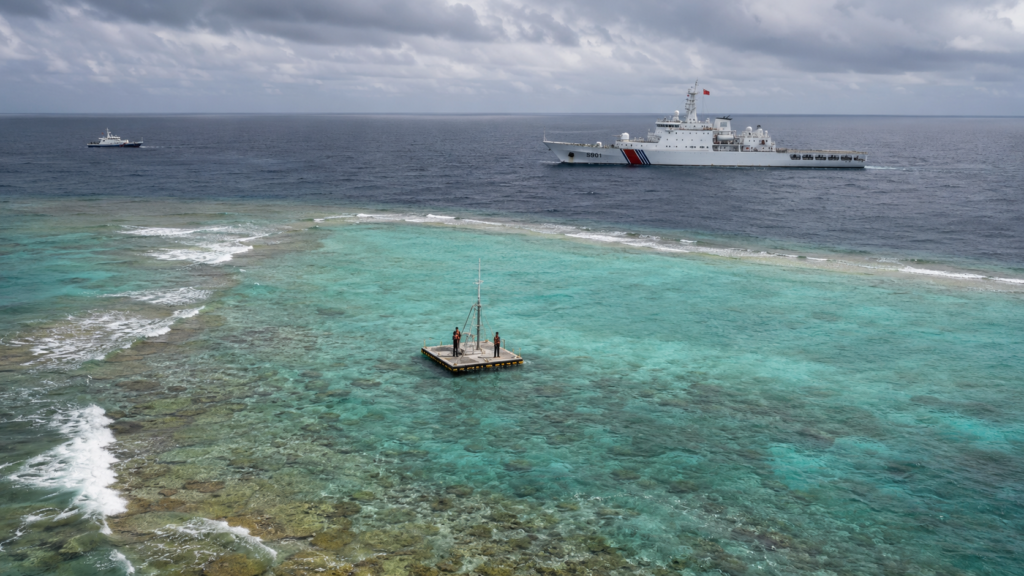
The National Task Force for the West Philippine Sea said on June 9 that Philippine authorities had confirmed the presence of a 6-by-6-meter Chinese floating structure with what appeared to be an antenna. Latest imagery from the Armed Forces of the Philippines also showed personnel on top of the platform.
The structure was first seen near the entrance of the shoal and later inside its lagoon.
The Department of Foreign Affairs has taken diplomatic action over what the task force described as the illegal presence of the structure. Manila said it would continue to act in line with international law and defend the country’s national interests.
China, as expected, rejected the Philippine position. Beijing again claimed sovereignty over Huangyan Dao, its name for Scarborough Shoal, and said activities there, including scientific research, fall within its rights. That answer will not reassure Filipinos. In the West Philippine Sea, “research” often sounds less like science and more like another excuse for control.
A Disputed Shoal
Scarborough Shoal sits about 200 kilometers west of Luzon and roughly 874 kilometers from China’s Hainan Island. That geography matters. The shoal lies close to the Philippines, supports Filipino fishing communities, and sits inside waters where Manila has clear maritime rights under international law.
China has maintained de facto control over the shoal since the 2012 standoff with the Philippines. Since then, Filipino fishermen have faced repeated access problems, while Chinese coast guard and maritime militia vessels have kept a steady presence in the area.
Scarborough Shoal lies within the Philippines’ 200-nautical-mile exclusive economic zone, but the 2016 arbitral ruling did not decide which country owns the shoal itself.
But it did reject China’s sweeping historic-rights claim and said China violated the rights of Filipino fishermen by blocking access to the shoal. Beijing still refuses to recognize the ruling.
A Small Platform, A Bigger Warning
Satellite images reported earlier this month showed a suspected structure or buoy near the shoal entrance in late May. Later imagery suggested it had disappeared, which means the situation may still be fluid. But that should not make the incident less serious.
In disputed waters, small objects can carry large political meaning. A buoy, barrier, platform, or antenna can help build a pattern of presence. Over time, presence can become control, and control can become a new “normal.”
That is why the Philippines cannot treat this as a minor maritime curiosity. Bajo de Masinloc is not a distant map issue. It is part of the daily struggle over fishing, sovereignty, and the rule of law in Philippine waters.