What happens when a fish bred for aquariums escapes into a volcanic crater lake, survives, multiplies, and becomes valuable enough that people begin farming it?
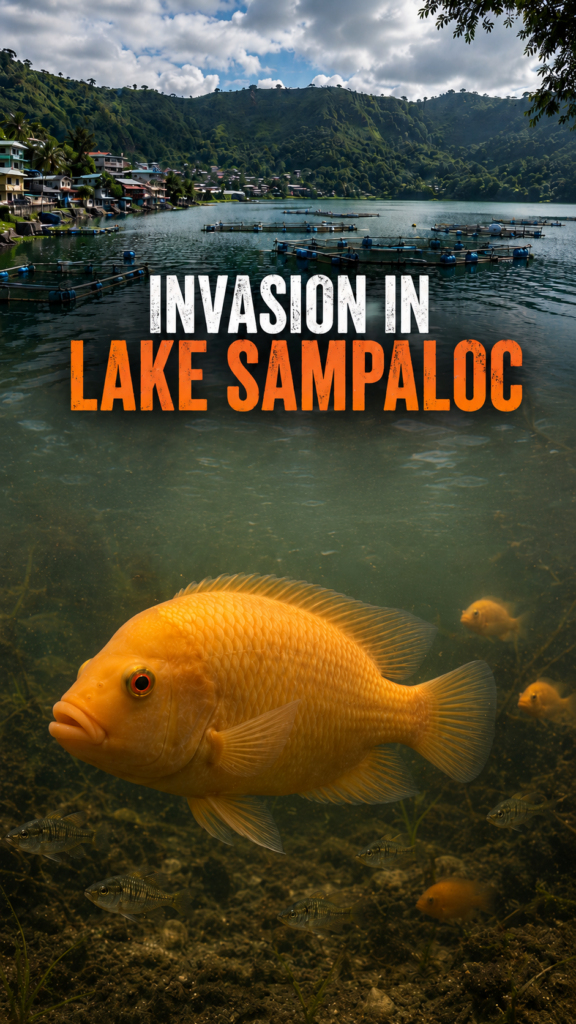
That’s the question playing out in San Pablo City, Laguna, where flashes of gold now dart through the murky waters of Lake Sampaloc, the largest of the city’s famed Seven Crater Lakes.
From Aquarium Escapee to Established Invader
Researchers Hannah Nicole Gasmen and Dr. Janice Ragaza of Ateneo de Manila University’s Department of Biology, working with the Ateneo Aquatic and Fisheries Resources Laboratory, published a study this past March in World Aquaculture documenting how these bright orange cichlids evolved from escaped aquarium pets into an entrenched wild population. Their paper, fittingly titled “Fenced and Feral,” traces the fish’s local origin story. They are believed to have broken loose from breeding facilities during a major typhoon, and have been turning up in the lake since at least 2016, the same year a foundational survey by Briones et al. found that nine of the lake’s twelve recorded fish species were already non-native.
Flowerhorn or Midas? A Name in Dispute
Then came a scientific plot twist. BFAR and the San Pablo City Agriculture Office have said the fish being pulled from the lake are technically Midas cichlids, close cousins of flowerhorns, native to Central America, and known to locals as “golden tilapia.” The exact identity is still being sorted out, but the ecological damage is not in dispute.
These are aggressive, highly territorial fish, and they’re colonizing a lake already under pressure from sewage, aquaculture runoff, and microplastics. Among the casualties is the ayungin (Leiopotherapon plumbeus), once a common catch in Sampaloc and now listed as Vulnerable by the IUCN, increasingly hard to find as the invaders crowd it out.
From Ecological Threat to Income Stream
Here’s the twist: the invader has become an income stream. Fishermen who find them tangled in their tilapia pens are now encouraged to keep and sell them rather than throw them back. Sold fresh, they fetch around ₱25; dried, the same fish can sell for up to ₱400 per kilo, according to San Pablo agriculture officials.
Even food-safety guidance is split. BFAR maintains the fish are safe when freshly caught, properly cleaned, and thoroughly cooked. The Ateneo researchers are more cautious, pointing to Lake Sampaloc’s pollution burden and urging that the fish be screened for parasites and contaminants before anyone treats them as a reliable food source. No human-infecting parasite has yet been confirmed in the lake’s population, but the researchers argue that gap in the data is a reason for caution, not comfort.
Some scientists, including aquaculture researcher Dr. Maria Rowena Eguia of De La Salle University, have flagged a further worry: the same cichlids have already begun appearing in Taal Lake, roughly 35 kilometers away, raising the possibility this isn’t a one-lake problem.
Lake Sampaloc is becoming a real-time test of whether an invasive species can still be controlled once it’s both an ecological threat and a source of income. Catching the fish may help contain it. Farming it could make the invasion permanent.