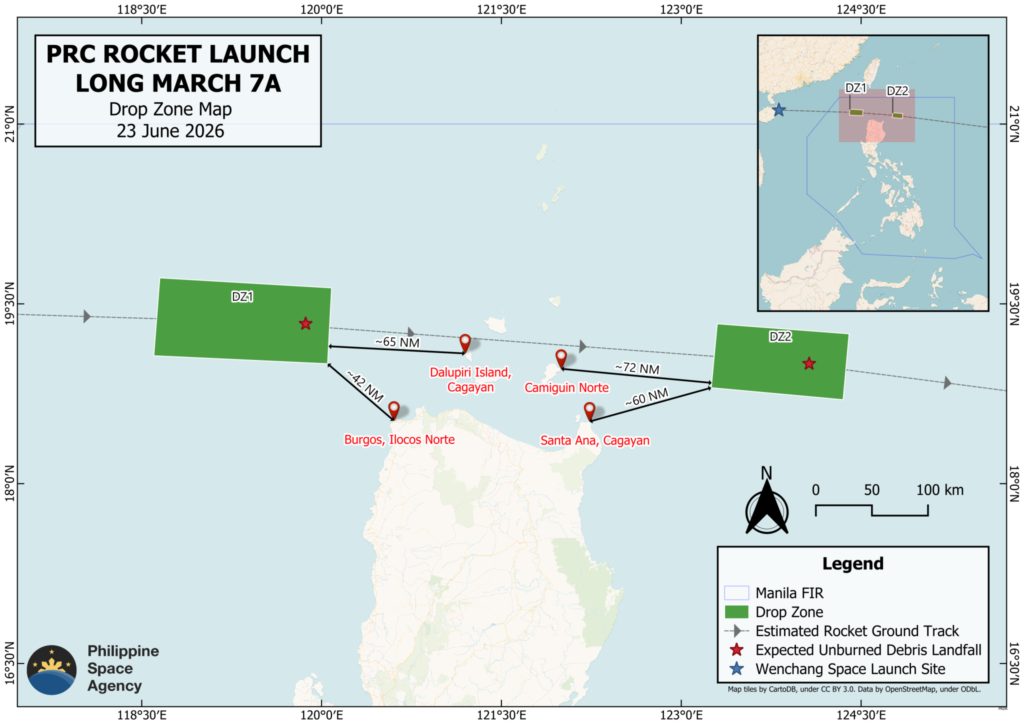
On June 23, PhilSA published a warning saying Chinese rocket debris was expected to fall inside the Philippine Exclusive Economic Zone. The projected drop zones were near Ilocos Norte and Cagayan.
This was not the first case in 2026, and it raises a fair question: why should Filipino waters keep absorbing the risk of China’s space launches?
Latest Warning Places Debris Zones Near Northern Luzon
According to the Philippine Space Agency, China launched a Long March 7A rocket from Wenchang, Hainan, at around 10:10 a.m. Philippine time on June 23, 2026.
PhilSA said expected debris was projected to fall in two drop zones. The first was around 42 nautical miles from Burgos, Ilocos Norte and 65 nautical miles from Dalupiri Island, Cagayan. The second was around 60 nautical miles from Santa Ana, Cagayan and 72 nautical miles from Camiguin Norte.
Both zones were inside the Philippine EEZ.
The warning came through a Notice to Airmen, or NOTAM, for “aerospace flight activity.” It helps warn aircraft and vessels away from danger. But a warning does not erase the risk, and it does not answer the bigger question of why these risks keep landing near Philippine waters.
Other Recent Chinese Rocket Debris Warnings
The June 23 case fits a recent pattern.
On June 17, PhilSA said debris from a Long March 12 launch was projected to fall within Philippine archipelagic waters, about 25 nautical miles from Puerto Princesa and 19 nautical miles from Tubbataha Reefs Natural Park. That is even more sensitive than the EEZ because archipelagic waters fall under Philippine sovereignty, subject to navigation rights.
On May 11, another PhilSA advisory said debris from a Long March 7 launch was projected inside the Philippine EEZ, around 34 nautical miles from Bajo de Masinloc, 97 nautical miles from Cabra Island in Occidental Mindoro, and 130 nautical miles from Busuanga, Palawan.
On January 19, PhilSA also confirmed a Long March 12 launch from Wenchang, Hainan. Expected debris was projected within Philippine archipelagic waters, around 22 nautical miles from Puerto Princesa and 14 nautical miles from Tubbataha Reefs Natural Park.
This is not about one rocket or one advisory. It is about repeated launch paths placing debris-risk zones near Philippine waters, reefs, fishing areas, coastal communities, aircraft routes and vessels.
Responsibility in Space Activities
China, like any other country, has the right to launch satellites and develop its space program. Space technology plays an important role in modern life, supporting communications, weather forecasting, disaster response, navigation, mapping, and scientific research. The Philippines itself benefits from these advancements.
However, the importance of satellites does not give China a blank check to shift the risks of its launches toward neighboring countries.
The Risk Is Low, But It Is Not Imaginary
The chance of anyone being directly hit by falling rocket debris is very low. But that does not make the debris harmless.
PhilSA has repeatedly warned that unburned rocket parts, including boosters and fairings, can endanger ships, aircraft, fishing boats and other vessels. Debris may also float in the sea, wash toward nearby coasts, or contain toxic remnants such as rocket fuel.
A fisherman or coastal resident who finds strange metal debris may not know whether it is safe to touch. A floating object can also become a navigation hazard. A falling object does not need to hit a town to become a problem.
What International Law Says About Rocket Debris
International law does not automatically ban a country from launching satellites just because parts of a rocket may fall into another state’s EEZ. The EEZ is not the same as land territory or territorial sea.
But that does not mean anything goes.
Under the law of the sea, other states enjoy certain freedoms in another country’s EEZ, including navigation and overflight. At the same time, they must have due regard for the rights and duties of the coastal state. In simple terms, China cannot act as if Philippine interests do not exist.
The Outer Space Treaty says states must conduct space activities with due regard to the interests of other states. It also allows consultations when a planned space activity may cause harmful interference.
The Liability Convention adds another important point: a launching state can be liable for damage caused by its space object, including parts of a launch vehicle.
The Philippines has every right to demand that China stop using launch trajectories that repeatedly place debris-risk zones in or near Philippine waters. At the very least, Beijing should provide earlier coordination, clearer public warnings, environmental-risk information, recovery cooperation, diplomatic consultations, and firm liability commitments in case of damage.