
For half a century, the story of Filipino migration has followed a familiar arc. Our brightest doctors, nurses, engineers, and IT specialists study hard, get licensed, and then leave. It’s a pattern so consistent that by the early 2000s, the Philippines was already recognized as one of the world’s top exporters of highly educated migrants, and remittances from workers abroad have long made up 7 to 9 percent of the country’s GDP.
Lately, though, a different phrase has started showing up in government press releases and startup panels: “Brain Gain.” The pitch is optimistic. Remote work, a maturing local tech scene, and government incentive programs are supposedly reversing decades of outflow, bringing skilled Filipinos and their networks, capital, and expertise back home.
The question is: how much of it actually shows up in the numbers?
The old story, by the numbers
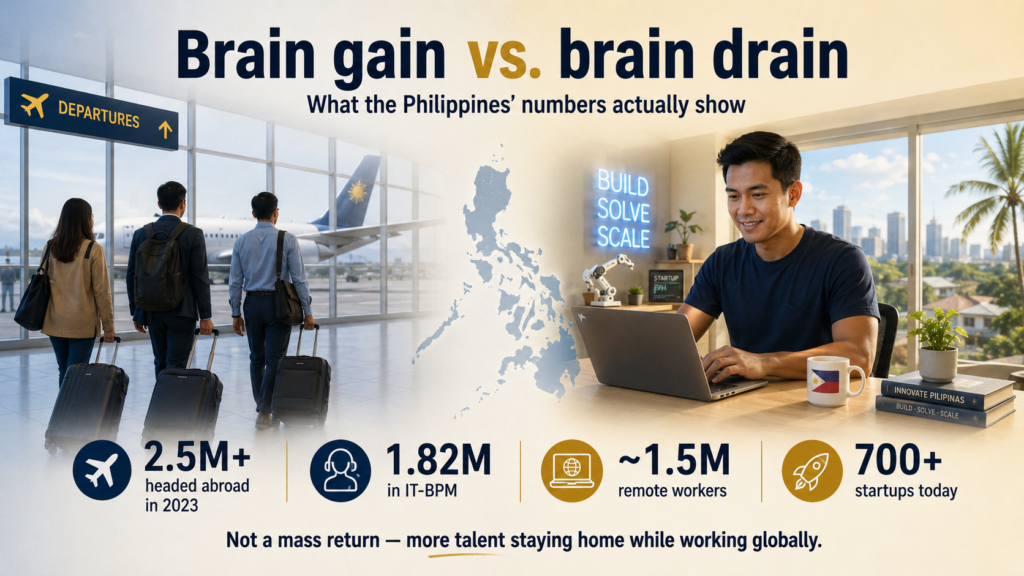
Before getting to the “brain gain” side, it’s worth sizing the “drain.” In 2023 alone, more than 2.5 million overseas employment certificates were issued to Filipino workers heading abroad. That’s the baseline any brain gain narrative has to be measured against, and it’s enormous.
The return programs bringing scientists and OFWs home
The most literal version of “brain gain” is the Department of Science and Technology’s Balik Scientist Program, which has been encouraging scientists to return since 1975 and was later strengthened into law in 2018. DOST Secretary Renato Solidum said that more than 120 Filipino scientists returned to the country between July 2022 and the end of 2024, working in fields like agriculture, health, and emerging technology, and that some of them chose to stay permanently rather than go back abroad. That’s a real, citable win, and it’s worth celebrating.
But context matters. By DOST’s own count, the program has brought back roughly 644 scientists total since 1975, which works out to an average in the dozens per year over almost 50 years (interestingly, DOST’s own published totals have varied across different reports over the years, which says something about how thinly this data gets tracked). The Philippines currently has only around 18,000 researchers nationwide, far below UNESCO’s benchmark of 380 researchers per million people for a country of this size. And the program’s 2026 budget is flat at ₱38 million. A PCIEERD official candidly acknowledged that the deciding factor for scientists abroad usually isn’t salary. It’s whether the opportunity and recognition at home can compete with the research infrastructure, career growth, and international networks they’ve built overseas.
A second, related program, iFWD PH (Innovations for Filipinos Working Distantly from the Philippines), launched in 2020 to help OFWs who lost overseas jobs during the pandemic pivot into technology-based small businesses, things like food processing, furniture-making, and agricultural equipment. As of the most recent figures, at least 626 OFWs nationwide have gone through the program’s training phase, 74 businesses have received funding, and the program has generated over 100 jobs. One standout: a returning electrical engineer from Canada now runs an agricultural machinery business whose multigrain seeder alone generated close to ₱6 million in sales in a six-month stretch and now sells in over 30 provinces.
These are genuinely good stories. They’re just small ones, measured in the hundreds of participants, not the thousands or millions the “brain gain” framing implies.
Remote work: where the real scale is
The more interesting version of brain gain isn’t about scientists flying home. It’s about talent that never has to leave in the first place, because the work now comes to them.
The Philippines’ IT-BPM sector employs roughly 1.82 million Filipinos and contributes more than $40 billion a year to the economy. Separately, an estimated 1.5 million Filipinos are now engaged in independent remote work or freelancing for overseas clients, a category that barely existed at scale a decade ago. In April 2025, the government approved a framework for a dedicated Digital Nomad Visa (Executive Order 86), though implementation guidelines from the Bureau of Immigration are still pending.
This is where the “keeping the talent, keeping the paycheck” version of brain gain is actually happening, and at a scale that dwarfs the formal return programs.
Global capital finding its way into local startups
The idea that returning or diaspora-connected Filipinos are bringing global capital into local tech mostly holds up. The local startup ecosystem has grown from around 100 active startups in 2015 to over 700 today, backed by an estimated $2.4 billion in venture capital (VC) funding between 2020 and 2024. That funding has cooled recently, dropping to about $86 million in the first half of 2025. Local VCs describe it as a “healthy reset” toward more disciplined, profitable startups rather than a reversal.
So, is “brain gain” real?
Yes, but probably not in the way the phrase suggests. There isn’t strong evidence of a mass wave of high-skilled Filipinos physically returning with global capital in tow. What the data does support is something a little less cinematic but arguably more durable: a growing share of skilled Filipino labor can now access global pay and global networks without emigrating at all, while a smaller, genuinely valuable trickle of scientists, engineers, and entrepreneurs choose to come home and are supported, however modestly, by programs built for exactly that purpose.
That’s still a meaningfully different country than the one brain drain statistics described twenty years ago. It’s just a quieter, more distributed kind of gain than the headlines imply.