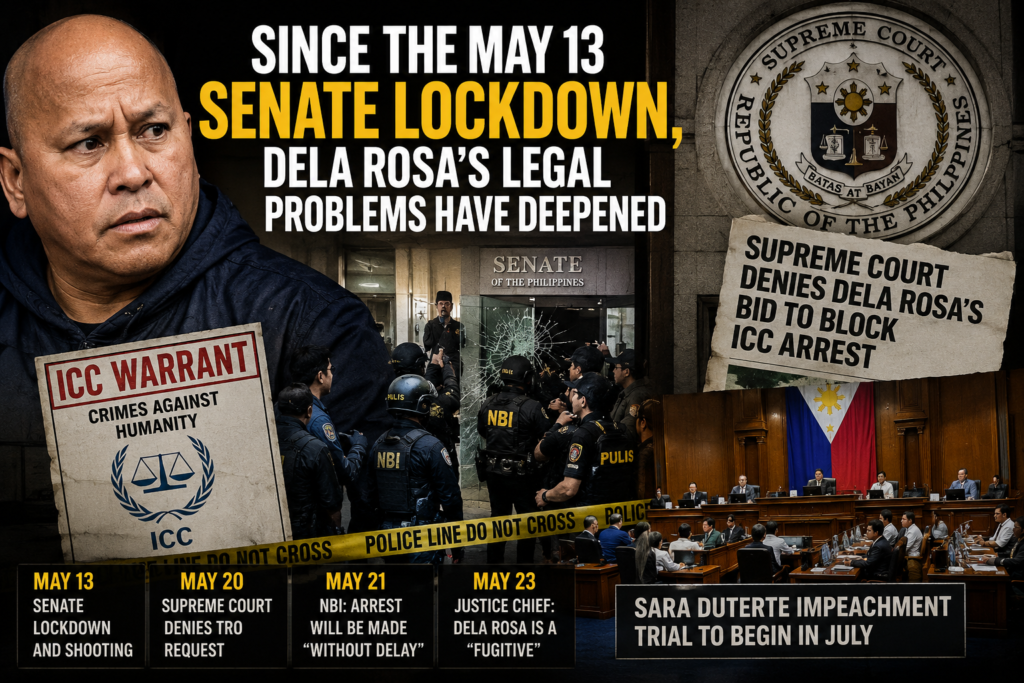
Nearly two weeks after the Senate lockdown, the drama around Senator Ronald “Bato” dela Rosa has moved from a dramatic standoff to a harder legal question: will Philippine authorities actually enforce the ICC warrant against a sitting senator?
The answer, at least from the Department of Justice and the National Bureau of Investigation, has become clearer. Justice Secretary Fredderick Vida has ordered authorities to enforce the International Criminal Court warrant against Dela Rosa, who is wanted over alleged crimes against humanity linked to Rodrigo Duterte’s drug war. Vida described him as a “fugitive from justice” and warned that anyone helping him evade arrest could face criminal charges.
Dela Rosa denies wrongdoing. His lawyers argue that the ICC warrant cannot be enforced in the Philippines without local judicial authority. But the Supreme Court has not given him the immediate protection he wanted.
Supreme Court Refuses to Stop Dela Rosa’s ICC Warrant
On May 20, the Supreme Court denied Dela Rosa’s request for a temporary restraining order that would have blocked his arrest and transfer to The Hague. The decision did not fully settle the broader constitutional issue. The Court still has to consider parts of his petition.
Still, the practical effect matters. The Court did not freeze the arrest process. That left the government room to move.
The NBI has since said it will arrest Dela Rosa “without delay.” Authorities also said they have leads on his whereabouts, although they have not disclosed where he may be. His legal team says he remains in the Philippines.
This is a sharp shift from the first hours after the Senate chaos. Then, the public question was whether Dela Rosa could use the Senate as a shield. Now, the question is whether anyone helped him escape that shield.
The Senate Lockdown Leaves More Questions
The most damaging update for the Senate may be the investigation into the May 13 gunfire. Initial claims suggested the Senate was under attack. But investigators later said CCTV footage and other evidence did not support that version.
Police investigators said there was “no attack” on the Senate. They also said more than 40 shots were fired during the incident, and that possible charges were being recommended against suspended acting Senate Sergeant-at-Arms Mao Aplasca and two other Senate security personnel.
Interior Secretary Jonvic Remulla said authorities reviewed footage from the Senate and the nearby GSIS complex and found no sign that NBI agents entered the Senate premises that night. Investigators also said Aplasca had allegedly given a “lock and load” instruction before the shooting.
Aplasca has disputed parts of the government’s version. That matters. This remains an investigation, not a final court finding. But the public picture has changed. The story no longer looks like a simple outside assault on the Senate. It looks like a confused, armed, highly political breakdown inside a national institution.
From Escape to Impeachment Court
Dela Rosa reportedly left the Senate in the early hours of May 14. Police are examining whether the chaos created the opening for his escape. That is a careful point, not a proven conclusion. But it is exactly the question the public will ask.
The timing made everything worse. Sara Duterte’s impeachment papers had just reached the Senate. Her trial is expected to begin in July, after the Senate convened as an impeachment court on May 18. So the same chamber shaken by gunfire, competing security claims, and Dela Rosa’s disappearance must now act as a court in one of the country’s biggest political trials.