Vietnam’s top leader To Lam is expected in Manila from May 31 to June 1, in a state visit that deserves more attention than a routine diplomatic stop. The agenda includes trade, security, and maritime cooperation. But the deeper backdrop is clear: the Philippines is widening its regional partnerships while China continues to press its claims in the South China Sea.
That does not mean Manila and Hanoi are forming an alliance. Vietnam remains careful and pragmatic, especially in its relations with China. Still, the visit matters because both countries understand the pressure created by Beijing’s sweeping nine-dash line.
A Diplomatic Visit With a Maritime Backdrop
President Ferdinand Marcos Jr. is set to welcome To Lam, who serves as Vietnam’s president and Communist Party chief. The visit also comes before To Lam’s expected appearance at the Shangri-La Dialogue in Singapore, one of Asia’s most closely watched security forums.
For Manila, Vietnam offers something different from outside partners such as the United States, Japan, Australia, or Canada. It is a fellow Southeast Asian claimant state. It also has its own long experience dealing with China in disputed waters.
That makes the visit useful even if it does not produce a dramatic announcement. In maritime diplomacy, practical steps often matter more than grand language. A coast guard mechanism, incident-prevention agreement, or joint exercise can build trust before the next crisis at sea.
From Post-War Ties to Strategic Partnership
The Philippines and Vietnam have not always looked like obvious partners. Both countries have overlapping claims in parts of the South China Sea, including areas linked to the Spratly Islands. Yet their relationship has moved steadily from post-war diplomacy toward practical cooperation.
The two countries established diplomatic relations in 1976, a year after the end of the Vietnam War. The bigger shift came in 2015, when Manila and Hanoi elevated ties to a strategic partnership. That framework helped expand cooperation in defense, security, trade, agriculture, and maritime affairs.
The relationship gained fresh momentum under Marcos. During his state visit to Vietnam in January 2024, the two governments signed agreements on maritime cooperation, including coast guard cooperation and incident prevention in the South China Sea. Those agreements gave substance to what could otherwise sound like routine diplomatic language.
The 2024 Coast Guard Drills Show Practical Cooperation
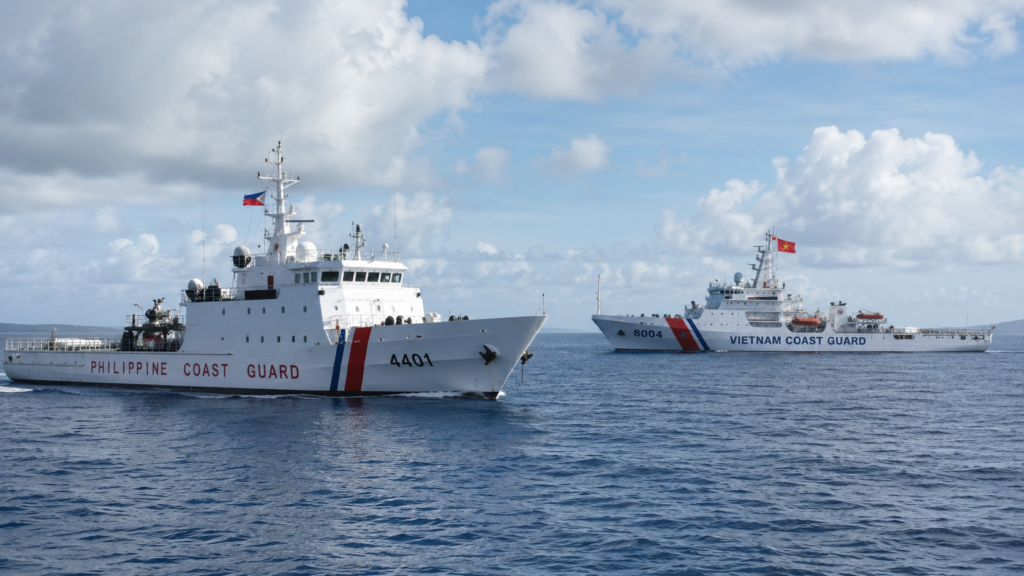
The clearest example came in August 2024, when the Philippine and Vietnamese coast guards held their first joint exercise. The drills included firefighting, search and rescue, and medical-response scenarios.
That may sound technical, but it was politically meaningful. Two countries with overlapping maritime claims showed they could cooperate at sea without pretending every dispute had disappeared. The exercise also sent a quiet message: Southeast Asian claimant states can manage their own differences while still working together on safety and order.
This matters because many South China Sea incidents begin with coast guard or maritime militia encounters, not formal naval battles. Better communication and shared procedures reduce the risk that a confrontation turns into something worse.
The Nine-Dash Line Remains the Backdrop
Beijing claims sovereignty over most of the South China Sea, a position rejected by the Philippines and Vietnam. In 2016, the arbitral tribunal in The Hague ruled that China had no legal basis to claim historic rights over resources within the nine-dash line beyond what is allowed under the United Nations Convention on the Law of the Sea. China rejected the ruling, but it remains central to Manila’s legal and diplomatic position.
Vietnam has also faced disputes with China over energy exploration, fishing, and maritime operations. The Philippines, meanwhile, has reported repeated incidents involving Chinese coast guard and maritime militia vessels near areas such as Ayungin Shoal, Scarborough Shoal, and other features inside its exclusive economic zone.
This shared pressure does not erase the differences between Manila and Hanoi. But it does create a common interest. Both countries benefit when maritime disputes are handled through international law rather than intimidation.
Not an Alliance, But a Useful Alignment
The Philippines should be realistic. Vietnam will continue to balance carefully. Hanoi has deep economic ties with China and a long tradition of strategic caution. It will not frame cooperation with Manila as an anti-China campaign.
But the Philippines does not need Vietnam to become a treaty ally. It needs more regional partners willing to defend maritime order, reduce the risk of incidents, and reject the idea that China’s map should decide the future of Southeast Asian waters.