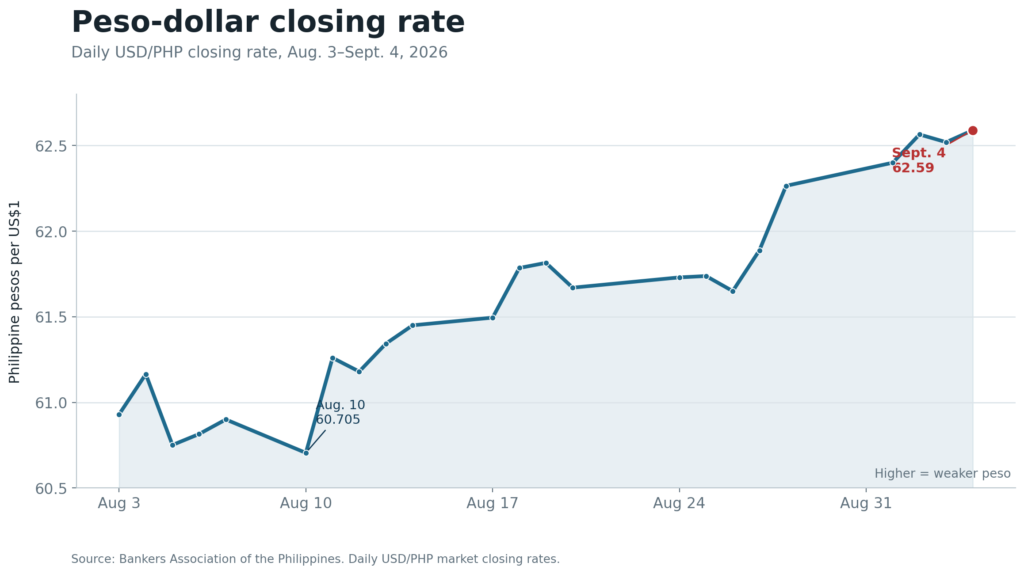
The Philippine peso closed at a new record low of ₱62.59 to the US dollar on September 4. It also weakened to ₱62.65 during the trading session.
The currency had posted four consecutive record-low closes between August 27 and September 2. After closing at ₱62.40 on September 1, it fell to ₱62.565 the next day. A slight recovery to ₱62.52 on Thursday proved brief.
This makes ₱62.59 the weakest nominal exchange rate in Philippine history. However, a higher dollar-peso rate does not necessarily mean the country faces a crisis worse than 1997. The speed of the decline and its effects on inflation, businesses and ordinary households also matter.
1997: The crisis that still haunts policymakers
The Asian financial crisis began in Thailand in July 1997. The Thai government stopped defending the baht after spending heavily to resist attacks by currency traders. Investors then pulled money from several Asian economies, exposing heavy foreign-currency debts and weaknesses in banks and corporations.
The Philippine peso lost about 34 percent of its value as capital fled the region. Inflation later rose above 10 percent, while economic growth collapsed.
Indonesia suffered an even more destructive currency crash. Malaysia, South Korea and other economies also came under pressure, although the damage varied considerably between countries.
The Philippine peso never reached today’s numerical level during that crisis. It weakened from around ₱26 in July 1997 to roughly ₱45 in 1998. Yet the speed of the collapse and the wider economic damage made 1997 far more traumatic than the exchange rate alone suggests.
2022: The peso reaches ₱59
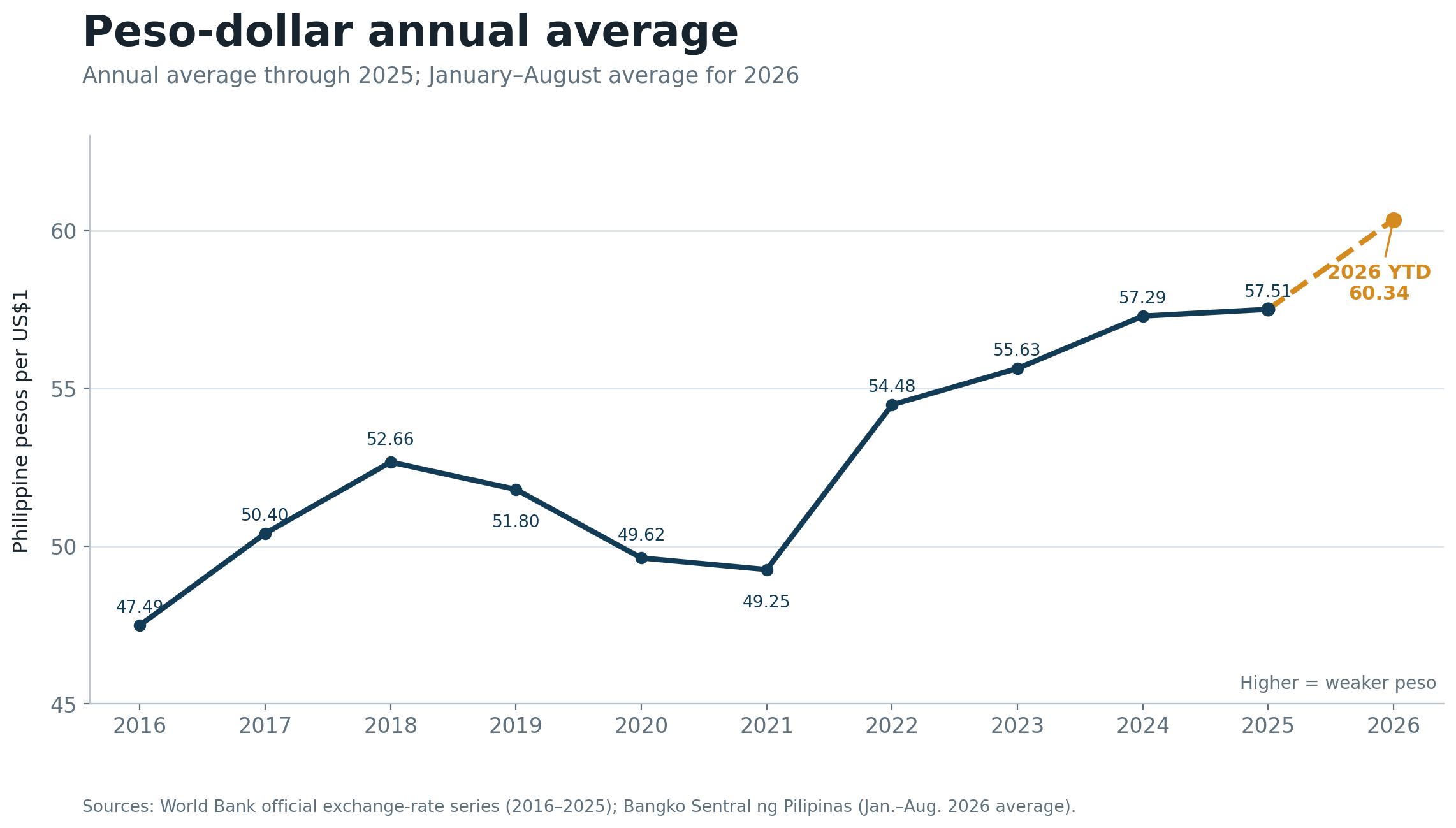
The next major milestone came in 2022. The US Federal Reserve raised interest rates aggressively, making dollar assets more attractive. Expensive oil and other imports also increased Philippine demand for dollars. The peso eventually reached a record ₱59.
Philippine authorities treated ₱60 as a dangerous psychological threshold. The BSP used an estimated $6.4 billion in foreign-exchange reserves during the first ten months of 2022 to support the currency. It also raised interest rates sharply.
The peso subsequently recovered. Intervention and higher Philippine rates helped, although weaker global demand for dollars also contributed. The ₱59 record stood for about three years.
2025–2026: One record after another
Pressure returned in 2025. The flood-control corruption scandal weakened investor confidence, while slower growth and earlier BSP rate cuts reduced support for the currency.
The peso set several records late that year before breaching ₱60 on March 19, 2026. It crossed ₱61 in April and ₱62 on August 28.
The decline continued despite three consecutive BSP rate hikes that brought the policy rate to 5 percent. Higher rates normally support a currency. However, markets interpreted the latest increase as relatively dovish because Governor Eli Remolona suggested that further hikes might not be necessary.
More recently, oil prices near $95 a barrel, elevated US Treasury yields and a firm dollar continued to weigh on the peso. Domestic political uncertainty may have added some short-term volatility, but economists viewed global pressures as the main immediate cause.
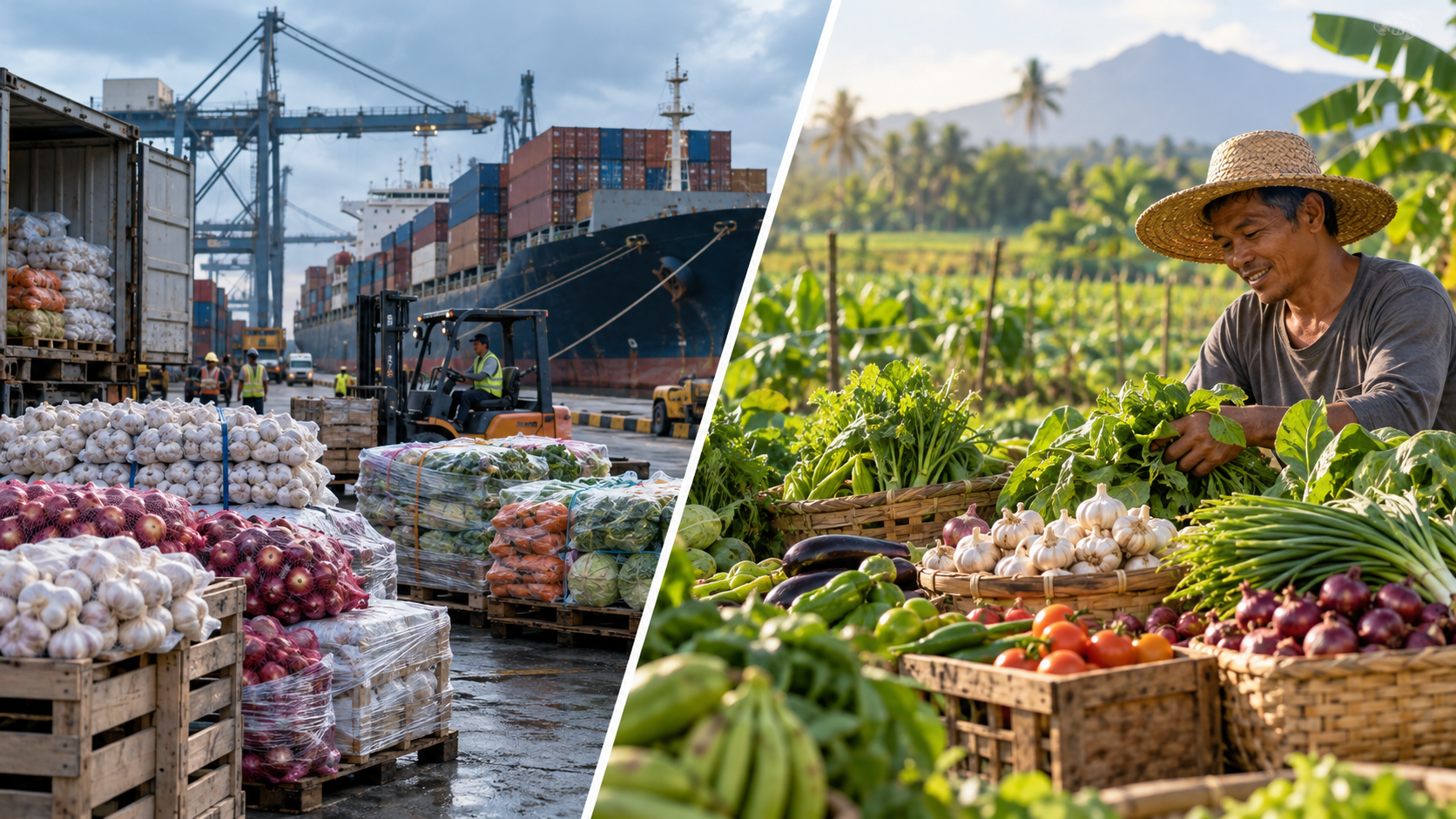
There is also a deeper domestic problem. The Philippines recorded a $5.97-billion trade deficit in July, 34.9 percent larger than a year earlier. Imports grew much faster than exports, maintaining heavy demand for dollars.
A record, but not another 1997
The current decline has been more gradual than the 1997 collapse. There has also been no publicly declared exchange-rate line comparable to the political focus on ₱60 in 2022.
Remolona has acknowledged that the BSP can slow the peso’s depreciation, but cannot fix the exchange rate without exhausting the country’s dollar reserves. The central bank instead intervenes to prevent extreme or disorderly movements.
However, the danger to consumers is no longer entirely hypothetical. Philippine inflation eased slightly to 6.1 percent in August, from 6.2 percent in July, but remained well above the BSP’s 2-to-4-percent target. Transport inflation accelerated to 13.5 percent as fuel costs increased.
The weaker peso is not the only cause of higher prices. Still, it makes imported oil and other foreign goods more expensive. The real question is not whether ₱62.59 looks alarming on paper. It is whether prolonged weakness further raises living costs, damages confidence or triggers disruptive capital outflows.