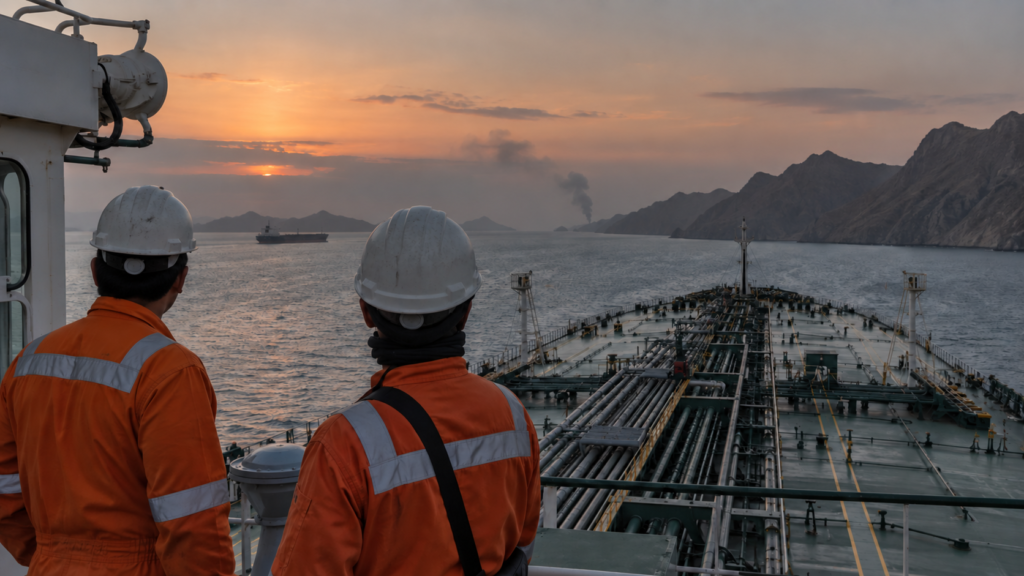
Two Filipino seafarers died on August 31 when unidentified projectiles struck the Saudi-flagged oil tanker Sidr near the Strait of Hormuz. The vessel caught fire during the attack, while its 14 other Filipino crew members survived.
Saudi Arabia has blamed Iran for the attack, but Iran has not publicly accepted responsibility.
The survivors returned to the Philippines on the evening of September 8. Officials from the Department of Migrant Workers and the Overseas Workers Welfare Administration met them at Ninoy Aquino International Airport. The government said they would receive medical care, psychosocial support and help processing their benefits.
Why ships remain at risk around Hormuz
The Strait of Hormuz connects the Persian Gulf to the Gulf of Oman and carries a significant share of the world’s traded oil. It has become a central battleground since the United States and Israel launched strikes against Iran on February 28. Iran has restricted shipping and targeted vessels that it says violated its rules, while the United States has tried to block Iranian oil exports. The resulting attacks, seizures and navigation restrictions have placed commercial crews directly in the path of the conflict.
British maritime authorities recorded 27 projectile strikes around the strait between July 6 and September 6. Shipping traffic remains far below normal levels, but thousands of crew members continue to work aboard vessels in the region.
Hundreds of Filipino seafarers have been exposed
The Sidr attack was not an isolated case. According to the DMW, security incidents around Hormuz had affected 421 Filipino seafarers aboard 31 ships since February 28.
Three Filipinos were killed, ten were injured and one remained missing. Although 268 had returned to the Philippines, officials estimated that around 3,000 Filipino seafarers were still aboard vessels in the wider Persian Gulf.
Merchant crews do not choose the political relationships of a ship’s owner or operator. Yet a vessel’s flag, ownership, cargo or previous port calls can determine whether armed groups treat it as a target.
Black Sea and Red Sea attacks brought earlier warnings
In July, Russian drone and missile attacks on commercial ships near Ukrainian ports killed Filipino seafarers in the northern Black Sea. By August 1, the DMW had recorded three Filipino deaths, 15 injuries and one missing crew member. In total, 236 Filipinos aboard 17 vessels had been affected.
Filipino crews had already suffered similar losses in the Red Sea. Houthi forces attacked and sank the Eternity C in July 2025. Three of its 21 Filipino crew members died, one remained missing and nine spent several months in Houthi custody.
The conflicts were different, but Filipino workers repeatedly found themselves exposed to weapons intended to pressure governments and influence wars.
Were the Sidr crew members given a genuine choice?
The Strait of Hormuz, Persian Gulf and Gulf of Oman have been designated a Warlike Operations Area. The DMW has repeatedly said Filipino seafarers may refuse to enter designated warlike or high-risk waters.
Under International Bargaining Forum rules, covered workers who refuse passage should receive repatriation at the company’s expense and compensation equal to two months of basic pay. Those who sail into the area qualify for additional pay and doubled compensation for conflict-related death or disability.
The central question is now whether the Sidr crew members were properly informed about those rights and given a genuine opportunity to refuse the voyage.
Migrant Workers Secretary Hans Cacdac said the DMW would investigate the seafarers’ manning agency if their right to refuse had been violated. That investigation matters because protection cannot depend only on what appears in a contract or government advisory.
Seafarers must receive clear information before entering dangerous waters. They must also be able to refuse without intimidation or fear that the decision will damage their careers.