The Philippines has offered to facilitate ASEAN discussions after deadly airstrikes in Myanmar, as China continues backing the country’s military-led authorities.
The latest violence sharpens a question facing Manila: can regional diplomacy produce meaningful change while Myanmar’s rulers retain backing from China and Russia?
Deadly airstrikes prompt Philippine response
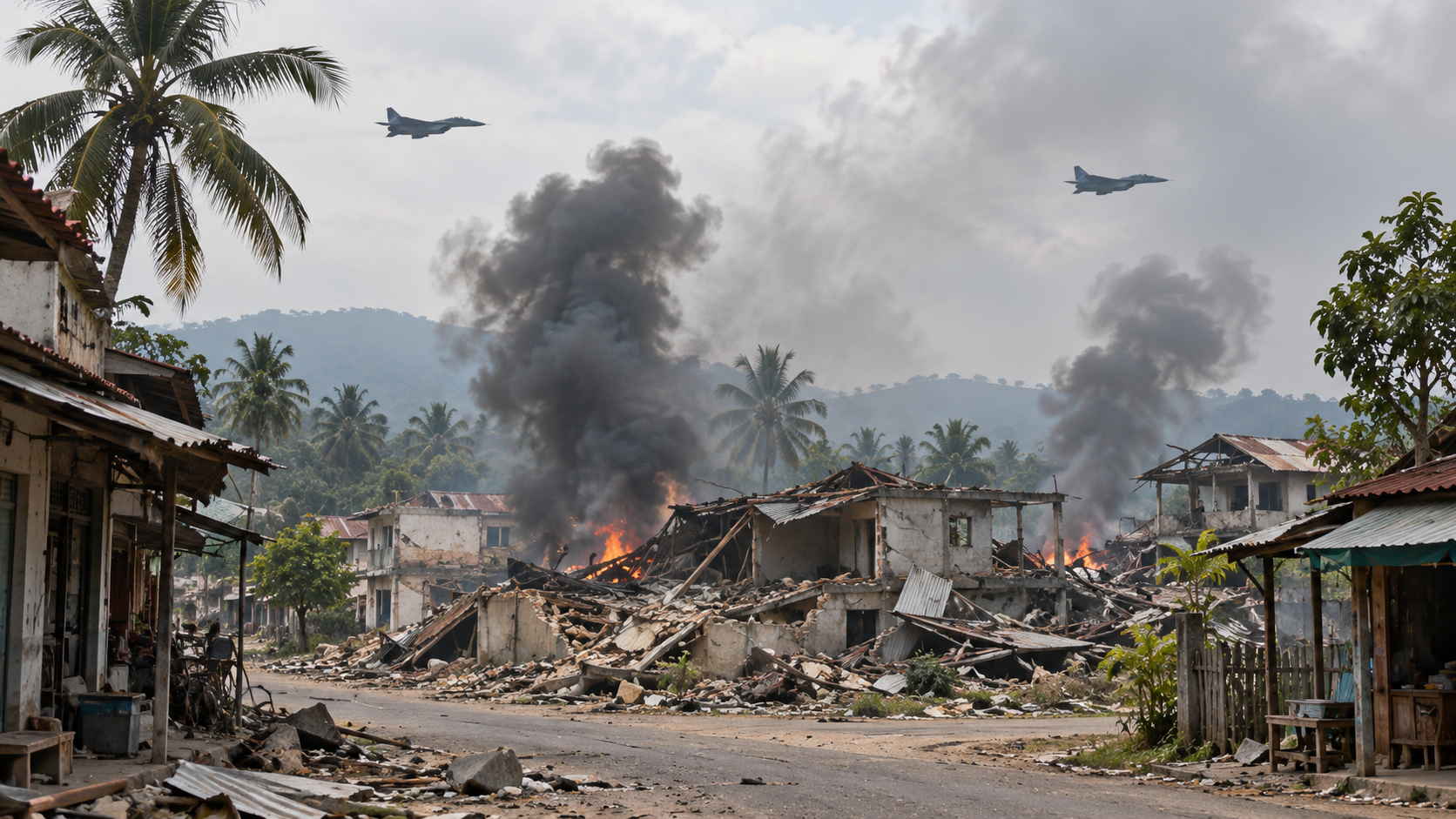
On September 28, military airstrikes hit a market in Kyauktaw, Rakhine State. UN human rights chief Volker Türk said the attacks reportedly killed at least 50 people and injured at least 58, including women and children.
On October 3, the Department of Foreign Affairs expressed concern over the deaths, injuries and destruction. It said Manila, as ASEAN chair, stood ready to facilitate discussions on assistance to Myanmar while following the bloc’s consensus-based approach.
From UN talks to ASEAN commitments
Manila’s response followed months of diplomatic efforts through ASEAN and the United Nations.
Foreign Affairs Secretary Ma. Theresa Lazaro discussed Myanmar with UN Secretary-General António Guterres in New York on September 21. They also addressed implementation of the ASEAN–UN Plan of Action for 2026–2030, a broader framework for cooperation across security, development and other fields.
Their meeting took place during UN General Assembly week. It produced no publicly announced Myanmar agreement. In her September 26 General Assembly address, Lazaro called more broadly for diplomacy and international law to resolve conflicts.
Manila’s responsibilities extend beyond those UN engagements. The Philippines chairs ASEAN in 2026, and Lazaro serves as the chair’s special envoy on Myanmar.
At the May summit in Cebu, ASEAN leaders reaffirmed their Five-Point Consensus and urged an end to indiscriminate violence. The plan, agreed after the 2021 military coup, calls for a cessation of violence, inclusive dialogue, envoy-led mediation and humanitarian assistance.
At their July 21 meeting in Manila, ASEAN foreign ministers again denounced violence against civilians and welcomed aid delivered through the ASEAN humanitarian coordination centre. They discussed criteria for assessing Myanmar’s progress and committed to submitting a comprehensive review to the next ASEAN leaders’ summit.
Those commitments give Manila a basis for engagement. The continuing attacks expose the gap between agreed principles and conditions on the ground.
Access remains a central obstacle
Lazaro has engaged a range of Myanmar stakeholders, including civil society and humanitarian actors. But the authorities rejected her request to meet detained former leader Aung San Suu Kyi, the DFA reported in July.
After a Red Cross representative visited Suu Kyi in August, the Philippines renewed calls for her unconditional release and wider access to detainees. That visit did not establish that Lazaro herself could meet her.
ASEAN ministers also welcomed Lazaro’s planned visit to Myanmar in the final quarter of 2026. She intends to lead a humanitarian mission aimed at expanding access to affected communities.
The need remains severe. UNICEF’s midyear report estimated that 16.2 million people required humanitarian assistance, with nearly 3.8 million internally displaced as of June.
China’s backing complicates regional diplomacy
Beijing has given Myanmar’s leadership substantial diplomatic support. Xi Jinping hosted military chief-turned-president Min Aung Hlaing in June. Their joint statement welcomed Myanmar’s elections and supported its full participation in ASEAN and the UN.
China’s ties also include military supplies. A UN special rapporteur’s 2023 investigation identified $267 million in arms and associated materials transferred by suppliers based in China, including Hong Kong, after the coup.
Beijing maintains influence over some ethnic armed groups too: Chinese pressure helped secure ceasefires, including an arrangement that returned Lashio to military control.
China has major interests in the Kyaukpyu deep-sea port, railways and oil and gas pipelines. Its support gives Myanmar’s authorities diplomatic and economic options despite ASEAN’s demands. The available evidence does not establish Chinese involvement in the September 28 attack.
Russia also backs Myanmar’s military
Russia is another important partner for Myanmar’s military leadership. Moscow has supplied arms and trained thousands of Myanmar soldiers, while expanding cooperation on energy and infrastructure. Min Aung Hlaing’s August visit to Russia followed agreements on a small nuclear power plant and investment in the Dawei port and economic zone.
A regional test beyond summit statements
Malaysia’s September 29 return of approximately 1,500 Myanmar nationals added another complication. Malaysia described the returns as voluntary; UNHCR questioned whether people taken from detention could freely choose and warned of serious protection risks.
For Manila, the next test is practical: securing wider political access, delivering aid and ensuring ASEAN’s review measures actual improvements. The UN meetings and ASEAN commitments provide opportunities for action. Continued violence makes results more urgent.