China is reinforcing its position across the South China Sea, increasing pressure on the Philippines and Vietnam. Recent developments include a renewed dispute over the BRP Sierra Madre, warnings about an emerging Chinese “iron triangle” in the Spratlys, and major construction at Antelope Reef in the Paracel Islands.
The Armed Forces of the Philippines recently rejected China’s claim that Manila had promised to remove the Sierra Madre from Ayungin Shoal. AFP spokesperson Rear Admiral Roy Vincent Trinidad said no binding commitment existed and vowed that the Philippines would “never abandon” the grounded warship.
Filipino troops have maintained an outpost aboard the Sierra Madre since the ship was grounded in 1999.
China’s Iron Triangle in the Spratlys
The AFP accused Beijing of trying to “rewrite history” over Ayungin. It pointed to China’s occupation of Mischief Reef in 1995, when Beijing initially described its structures there as shelters for fishermen.
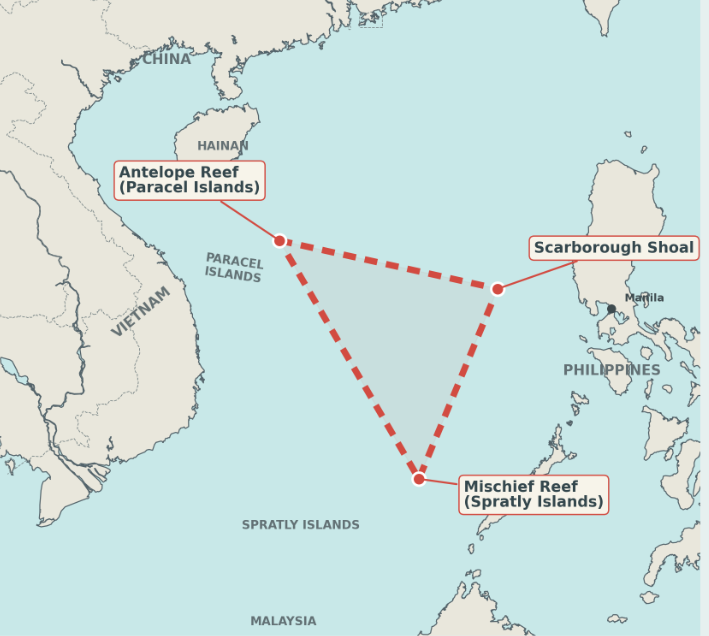
Mischief Reef is now a fortified base with a runway, radar systems, missile shelters and naval facilities. Together with Subi Reef and Fiery Cross Reef, it forms what Philippine officials describe as China’s “iron triangle” in the Spratly Islands.
The three bases can support aircraft, warships and coast guard operations across large parts of the South China Sea.
Mischief Reef is particularly important to the Philippines. The 2016 arbitral tribunal found that it is a low-tide elevation within the Philippine exclusive economic zone and continental shelf. It cannot generate a territorial sea or an exclusive economic zone of its own.
China nevertheless controls the feature and maintains a major base there.
Manila files 27 protests in six months
The Philippines filed 27 diplomatic protests against China between January and June, according to the National Maritime Council.
The protests formally record Manila’s rejection of Chinese actions, but they have not ended Beijing’s maritime presence. The AFP counted 26 Chinese naval and coast guard vessels around four West Philippine Sea features from July 21 to 26.
China later conducted joint air and naval exercises around Bajo de Masinloc, also known as Scarborough Shoal.
China expands another contested reef
The West Philippine Sea is not the region’s only contested maritime area. China has completed the first reclamation phase at Antelope Reef in the Paracel Islands, where Vietnam faces similar pressure.
The Paracels lie in the northern South China Sea, between China’s Hainan Island and the Vietnamese coast. China, Vietnam and Taiwan claim sovereignty over them.
China took control of the entire archipelago after defeating South Vietnamese forces in a naval battle in 1974. Vietnam has never abandoned its claim and continues to protest Chinese construction.
Satellite images show that China has created an artificial island at Antelope Reef nearly six kilometers long. It includes a deep-water harbor, a 680-meter wharf and a helicopter pad. Excavation along one edge could mark the beginning of a runway, although no paving had been laid when the images were assessed.
Chinese state media have described the project as infrastructure for scientific research and weather forecasting. Its size and location could also allow China to support surveillance, aircraft and naval operations in the northern part of the sea.
Antelope Reef is not within the Philippine EEZ, and the Philippines does not claim the Paracels. However, Vietnam confronts a pattern already familiar to Filipinos: China occupies a contested feature, builds permanent infrastructure and strengthens its control despite legal and diplomatic objections.