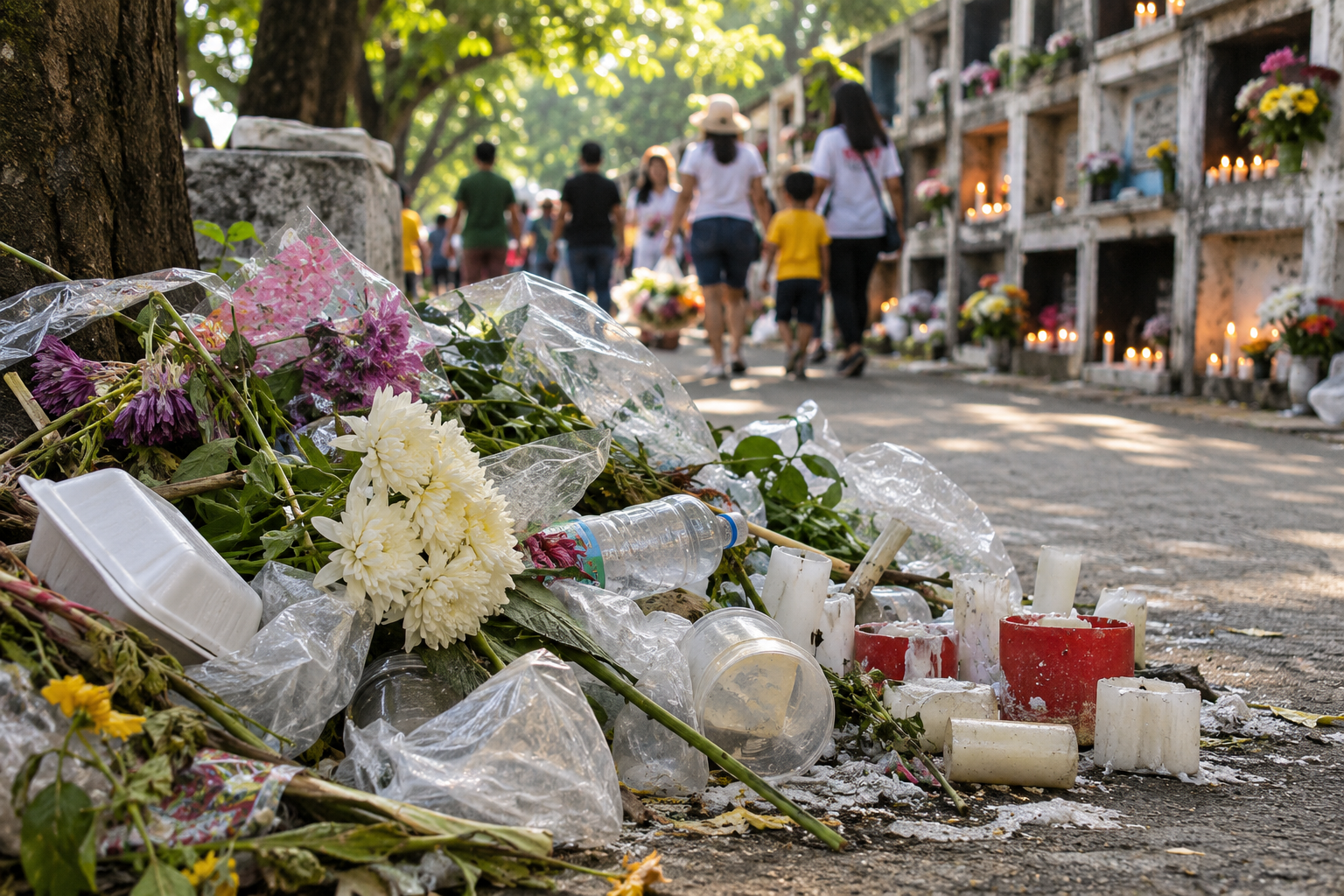
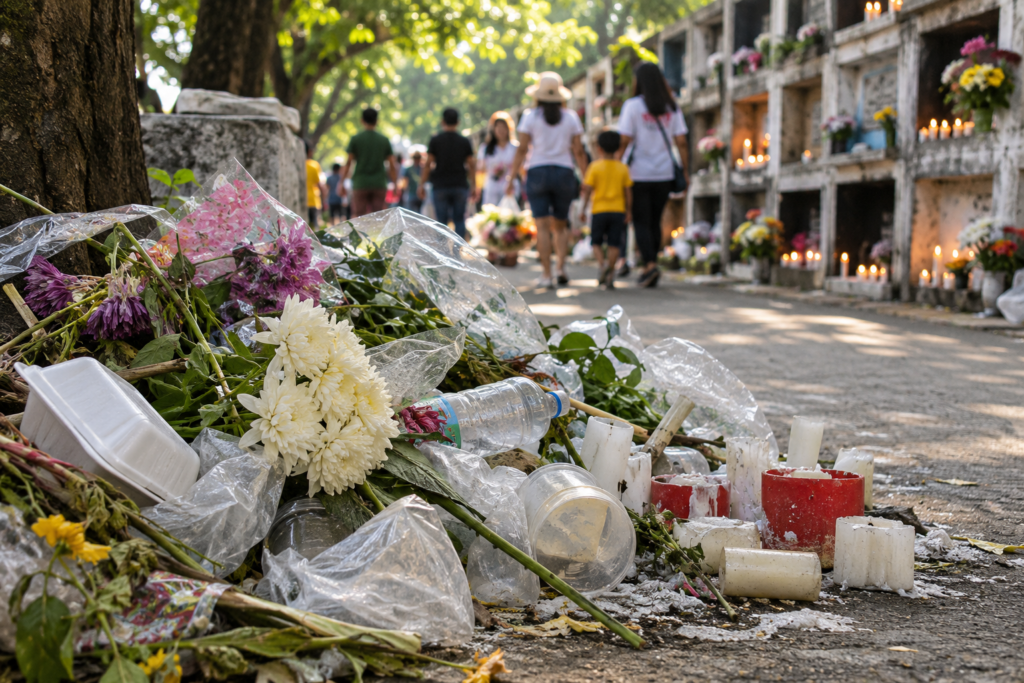
Every year, millions of Filipinos gather at cemeteries to remember their departed loved ones. But alongside the candles, flowers, and family reunions, Undas also leaves behind enormous quantities of waste. As local authorities tackle the annual cleanup, environmental advocates are calling for more sustainable ways to observe one of the Philippines’ most cherished traditions.
Manila cemeteries collect 182 tons of waste
Even before the conclusion of this year’s observance, Manila’s two major public cemeteries had collected an extraordinary amount of garbage. According to Manila’s Department of Environment and Public Services, workers collected 182 metric tons of waste between October 28 and 8 a.m. on November 1. Of that total, 97 tons came from Manila North Cemetery and another 85 tons from Manila South Cemetery.
The figures are particularly striking because they were recorded before the busiest hours of All Saints’ Day and the November 2 observance of All Souls’ Day. For perspective, the same two cemeteries recorded approximately 278 metric tons of waste on November 1 last year, according to environmental group BAN Toxics.
The figures illustrate the substantial cleanup challenges associated with Undas.
The environmental problems behind the celebrations
Much of the waste comes from ordinary items that visitors bring to cemeteries. The problem is not the tradition itself, but the growing reliance on disposable products and the difficulty of managing waste during major public gatherings. Plastic bottles, food wrappers, disposable bags, candle packaging, and artificial flowers can accumulate rapidly when large crowds gather. Some decorations combine plastic, metal, and other materials, making recycling more difficult. Improperly discarded waste can also obstruct drainage systems or eventually enter waterways.
Who pays for the cleanup?
The environmental consequences also create an economic burden. Local governments must deploy sanitation workers, garbage trucks, collection equipment, and additional personnel before, during, and after Undas.
In Quezon City, sanitation teams conducted cleanup operations at Bagbag Cemetery and Novaliches Public Cemetery on November 1. These operations require public resources that municipalities could otherwise use for regular waste management and other services.
Better waste prevention could reduce both the environmental impact and the pressure on local sanitation services.
Can Undas become more environmentally friendly?
Environmental organization BAN Toxics has urged Filipinos to reduce waste while preserving the solemnity of the occasion.
Several practical changes could make a difference:
- Choose reusable containers for food and drinks instead of disposable packaging.
- Avoid unnecessary plastic decorations, particularly those discarded after a single visit.
- Consider locally grown natural flowers, preferably with minimal packaging, while ensuring proper disposal afterward.
- Separate recyclable and biodegradable waste where appropriate collection facilities are available.
- Take home personal garbage when cemetery disposal facilities are inadequate.
Local authorities can also contribute through clearly marked collection areas, better waste segregation, sufficient garbage bins, and cooperation with vendors.
These measures need not interfere with religious observances or family traditions.
Preserving tradition without leaving pollution behind
Undas remains a meaningful expression of Filipino faith, family unity, and respect for previous generations. Yet its environmental footprint raises an important question about how traditions should adapt to modern challenges.
With more than 1.3 million visitors recorded at Manila North Cemetery on November 1 alone, even small changes in individual habits could make a considerable difference.
Honoring loved ones and protecting the environment should not be competing priorities. Perhaps one of the most meaningful ways to respect previous generations is to leave a cleaner, healthier Philippines for those who come next.