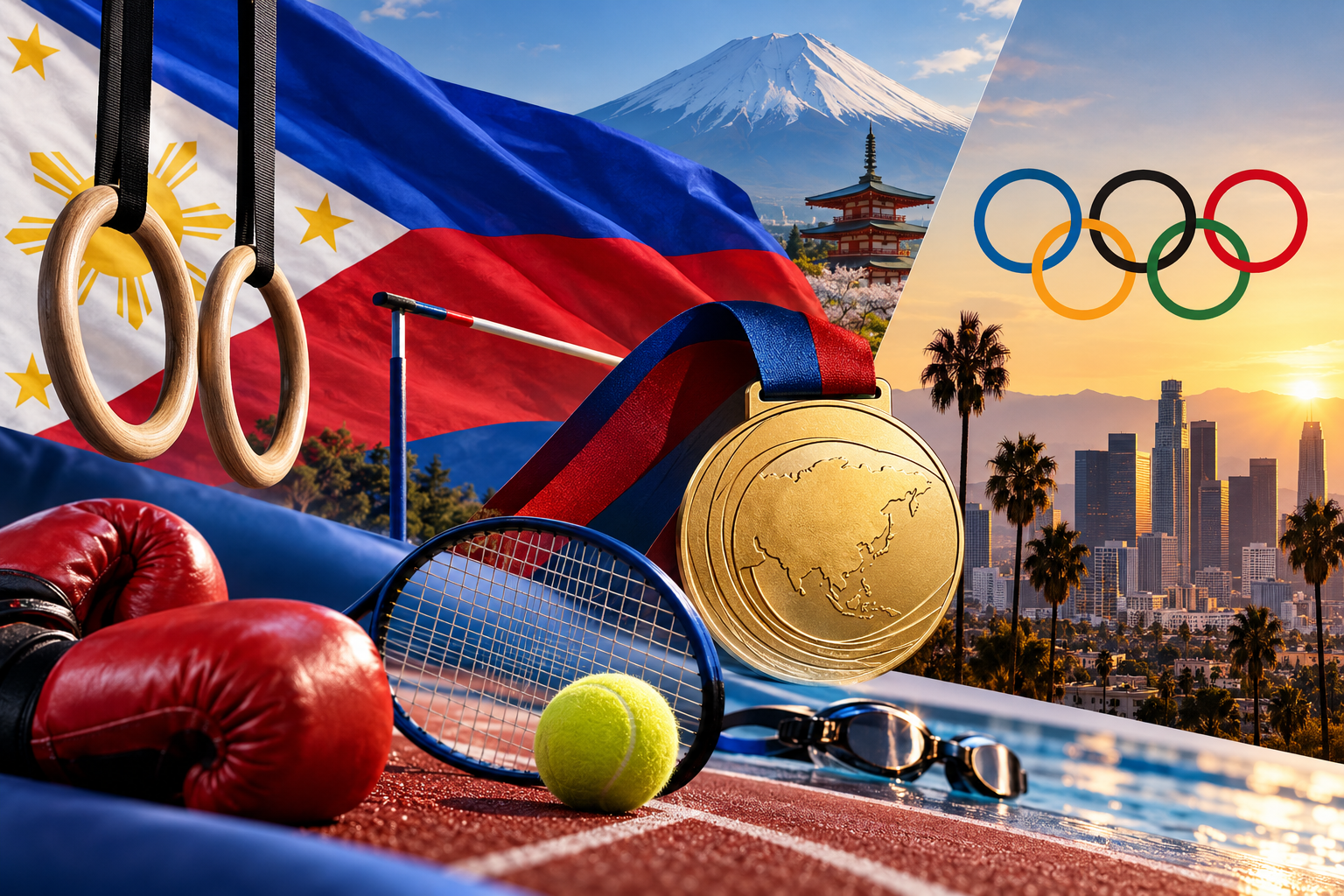
Filipino athletes have delivered one of the Philippines’ strongest international sporting performances in decades. At the 2026 Asian Games in Japan, the country collected 29 medals, including four golds, its largest medal haul since 1966. The achievement highlights the growing strength of Philippine sports, but also raises a bigger question: Can the country turn individual victories into lasting international success?
Filipino athletes shine at the 2026 Asian Games
The Asian Games, held in Aichi-Nagoya from September 19 to October 4, brought together some of Asia’s strongest sporting nations. The Philippines finished 17th overall with four gold, nine silver, and 16 bronze medals.
Two-time Olympic champion Carlos Yulo led the Philippine delegation, winning gold in both the men’s floor exercise and vault competitions. Pole vaulter EJ Obiena successfully defended his Asian Games title, clearing 5.91 meters to establish a new Games record. Another breakthrough came from Jeus Gabriel Derick Yape, who won gold in virtual taekwondo and bronze in individual poomsae.
Tennis star Alex Eala added a bronze medal in women’s singles, further strengthening her reputation as one of the country’s most promising international athletes.
The achievements extended well beyond these familiar names.Filipino competitors also secured medals in boxing, archery, weightlifting, athletics, beach volleyball, esports, and several other disciplines. For a country where basketball traditionally dominates sporting attention, the diversity of these results is particularly encouraging.
What makes Filipino champions successful?
International sporting success rarely comes from talent alone. Yulo developed his gymnastics career through years of intensive training in Japan. Obiena has spent much of his professional career training and competing in Europe, while Eala developed her tennis skills at Spain’s prestigious Rafa Nadal Academy. Their experiences demonstrate the importance of high-quality coaching, specialized facilities, international competition, and long-term financial support.
Overseas training has helped Filipino athletes gain access to resources that are not always readily available at home. However, these opportunities can be expensive, particularly for young athletes whose families lack the means to fund international development.
The challenge is ensuring that promising Filipino competitors can access similar opportunities regardless of their financial background.
Beyond medals: Building a stronger sports system
The Philippines has made important progress in international sports, including Yulo’s historic double-gold performance at the 2024 Paris Olympics. Yet successful athletes do not automatically indicate a consistently strong national sports development system.
Investment in grassroots programs, school athletics, coaching, medical support, and regional training facilities remains essential.
Government incentives reward medal winners, but support during the years before an athlete reaches international competition may be even more important.
The 2026 Asian Games also demonstrated the potential of less-publicized sports. Developing these disciplines could expand opportunities for young Filipinos while reducing dependence on a handful of established stars.
Looking ahead to Los Angeles 2028
The next Summer Olympics, scheduled for Los Angeles in 2028, will provide another major opportunity to measure Philippine sporting progress.
Experienced competitors such as Yulo and Obiena have already demonstrated that Filipino athletes can challenge the world’s best. Younger talents, including Eala and emerging athletes in other disciplines, offer further reasons for optimism. However, future Olympic success will depend on more than the performances of today’s champions. The Philippines needs to identify promising athletes early, support their development, and provide opportunities to compete internationally.