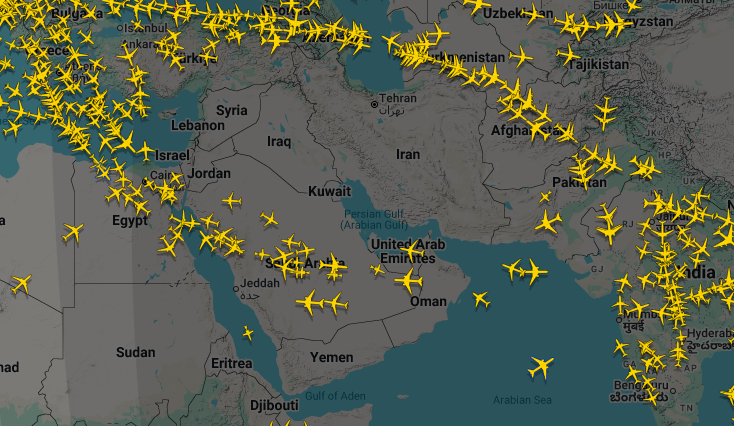
Flight diversions became unavoidable over the weekend as multiple countries closed sections of Middle East Airspace following missile exchanges between the United States, Israel, and Iran. What began as a rapid military escalation quickly spilled into civilian aviation, forcing airlines to cancel services, reroute aircraft, and turn back long-haul flights already en route to Gulf destinations.
Several Philippine-bound and Middle East-bound services were directly affected. A Riyadh-bound aircraft returned to Manila after airspace restrictions were imposed, while dozens of other international flights were cancelled as authorities restricted civilian corridors across Iran, Iraq, Israel, Kuwait, Bahrain, Qatar, and the United Arab Emirates.
Missiles, Interceptions, and Closed Skies
The aviation shutdown followed coordinated strikes on Iranian military facilities on February 28. Within hours, Iran launched a large retaliatory wave of ballistic missiles and drones aimed at Israel and Gulf-based USA military sites.
While many of the projectiles were intercepted, some landed in civilian areas. Residential neighborhoods in Israel reported casualties and structural damage. In the Gulf, debris and impact incidents were recorded near key infrastructure sites in the United Arab Emirates, including areas close to Dubai International Airport and commercial districts. Kuwait’s airport also reported damage linked to missile activity, prompting immediate safety restrictions.
The situation even drew in Cyprus after missiles were detected traveling in its direction, though authorities clarified it was not the intended target.
For aviation regulators, that threshold (active missile exchanges across commercial corridors) is enough to ground traffic. The Gulf normally functions as one of the busiest transit intersections in the world, linking Southeast Asia with Europe and Africa. When those skies close, ripple effects extend far beyond the region.
Flight Diversions on Philippine Routes
On the Philippine side, at least 23 international flights were cancelled and several diverted as a direct result of the airspace restrictions. Philippine Airlines listed cancellations on routes connecting Manila with Doha, Riyadh, and Dubai. Cebu Pacific also suspended select Dubai services and offered rebooking flexibility for affected passengers.
The disruption did not stop with direct Gulf routes. Aircraft traveling between Asia and Europe were forced to detour around restricted zones, adding hours of flying time and complicating onward connections. Diversions to alternate airports became common while airlines waited for clearance updates.
When major hubs such as Dubai and Doha restrict operations, even passengers not flying into conflict zones feel the impact. Transit schedules collapse first, then aircraft positioning becomes strained, and finally global routes begin to stack up with delays.
Afghanistan–Pakistan tensions are not directly tied to the current escalation, but instability in that corridor narrows alternative routing options when Gulf airspace is restricted.
Why Filipinos Are Watching Closely
The impact is magnified for the Philippines because of the size of its workforce in the region. The Philippine Statistics Authority’s 2024 estimate placed the number of Overseas Filipino Workers at 2.19 million, with Saudi Arabia accounting for 21.9 percent and the United Arab Emirates 12.4 percent of that total. That translates to roughly 479,600 OFWs in Saudi Arabia and about 271,600 in the UAE, based on PSA figures.
Separate embassy estimates suggest the broader Filipino community in the UAE, including long-term residents, reaches around 700,000.
The Department of Foreign Affairs has advised Filipinos in affected areas to remain vigilant and monitor embassy announcements. At this stage, no large-scale evacuation has been announced, but agencies are monitoring developments closely as host governments assess security conditions.
For passengers currently booked on Middle East routes, flexibility remains key. Airlines are adjusting schedules daily, and travelers are being encouraged to confirm flight status directly with carriers before heading to the airport.