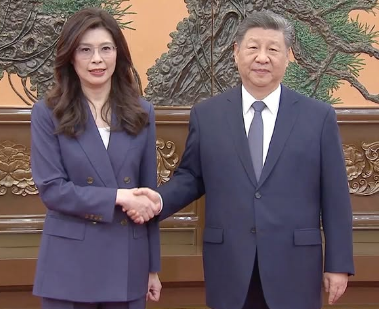
On April 10, Chinese President Xi Jinping met Taiwan opposition leader Cheng Li-wun in Beijing, as Chinese warplanes flew near the island the same day. Two days later, on April 12, Beijing unveiled a package of “incentives” for Taiwan.
The sequence reflects a clear pattern: diplomacy, military pressure, intimidation, and economic outreach unfolding in parallel. With tensions rising across the Taiwan Strait, countries like the Philippines are watching closely, aware that escalation would have immediate regional consequences.
The Xi–Cheng Meeting and Taiwan’s Political Divide
The meeting took place at the Great Hall of the People in Beijing. Cheng leads the Kuomintang (KMT), Taiwan’s main opposition party, which supports closer engagement with China. This contrasts with the ruling Democratic Progressive Party, which rejects Beijing’s sovereignty claims.
Xi reiterated that Taiwan independence would “absolutely not be tolerated,” framing reunification under the “One China” principle as inevitable. Cheng described her visit as a peace effort and called for dialogue to reduce tensions.
The trip has divided opinion in Taiwan. Critics warn that engagement under these terms risks reinforcing Beijing’s narrative. Taiwan’s government responded by stressing that only its people can decide the island’s future.
Warplanes and the Message Behind Them
At the same time as the meeting, Taiwan’s defense ministry reported multiple Chinese warplanes operating near the island. The timing highlighted a familiar pattern: military pressure deployed alongside political messaging.
This approach mirrors China’s behavior in the West Philippine Sea. Chinese vessels regularly operate in contested waters under the nine-dash line, asserting presence without open confrontation. These “grey zone” tactics rely on constant pressure rather than direct conflict.
“Incentives” With Political Conditions
On April 12, China announced 10 measures aimed at Taiwan following the visit. These include resuming flights, allowing residents from Shanghai and Fujian to visit Taiwan, easing inspection standards for Taiwanese food and fishery products, and permitting Taiwanese television content in China, provided it meets political and content guidelines.
Beijing also proposed a regular communication mechanism with the KMT, signaling a preference for engagement with political groups more open to closer ties.
However, these measures are tied to a clear condition: opposition to Taiwan independence. Taiwan’s government rejected them as “poisoned pills,” arguing they are designed to create dependence while advancing political objectives.
The KMT welcomed the announcement, calling it a “gift” to the Taiwanese people.
The Broader Geopolitical Picture
The Taiwan Strait remains a critical corridor for global trade and a central point in US–China rivalry. Japan has also signaled that stability in the Strait is essential for its own security.
For the Philippines, the implications are direct. Taiwan lies just north of Luzon, and any conflict would affect regional airspace and sea routes. Manila’s growing defense ties with the United States, including expanded access to military bases and joint exercises, further place it within the regional security framework.