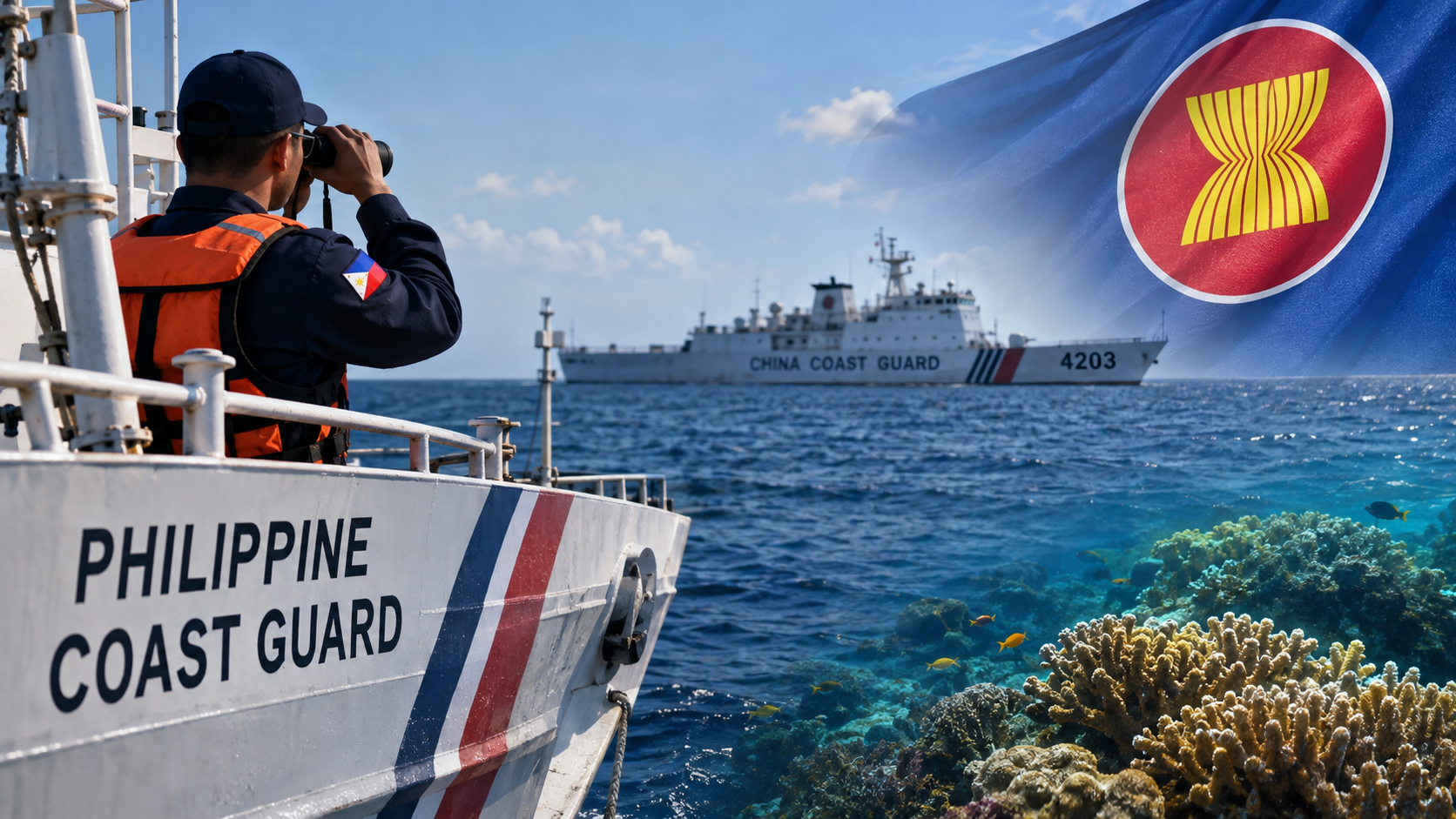
The Philippines will host a new ASEAN Maritime Centre, following an important agreement reached during the 49th ASEAN Summit in Manila. The initiative aims to strengthen regional cooperation on maritime security, environmental protection, and the sustainable use of marine resources, at a time when tensions in the South China Sea continue to challenge Southeast Asian stability.
The decision represents a diplomatic achievement for President Ferdinand Marcos Jr.’s administration and could give the Philippines a more prominent role in shaping ASEAN’s maritime agenda.
However, important questions remain about how the centre will operate and whether it can make a meaningful difference in waters where Chinese vessels have repeatedly confronted Philippine ships.
ASEAN moves forward with a Philippine-based maritime centre
On November 14, ASEAN foreign ministers adopted the concept note and terms of reference for the planned ASEAN Maritime Centre during their meeting in Pasay City. The initiative builds on the ASEAN Leaders’ Declaration on Maritime Cooperation, adopted during the 48th ASEAN Summit in Cebu on May 8.
Foreign Affairs Secretary Ma. Theresa Lazaro described the latest agreement as an important achievement of the Philippines’ ASEAN chairmanship.
The center is envisioned as a regional knowledge hub and coordination platform, bringing together expertise from governments, academic institutions, maritime authorities, and other organizations. Its activities could cover maritime safety, information-sharing, environmental protection, sustainable fisheries, and the broader blue economy.
The agreement also complements ASEAN’s efforts to strengthen cooperation among national coast guards and maritime law enforcement agencies through the ASEAN Coast Guard Forum. However, the maritime centre will not function as a regional navy or an independent enforcement agency. Its primary purpose will be to support cooperation and information-sharing rather than conduct patrols or intervene directly in territorial disputes.
Several operational questions remain unresolved, including its organizational structure, funding, and the extent to which countries outside ASEAN could participate.
Rising tensions in the West Philippine Sea
The new ASEAN Maritime Centre comes amid growing tensions in the West Philippine Sea, where Chinese Coast Guard vessels have repeatedly confronted Philippine ships operating in disputed waters.
In September, the Philippine Coast Guard accused a Chinese Coast Guard vessel of deliberately ramming the BRP Datu Magat Salamat during a mission to assist Filipino fishermen. Two months earlier, a confrontation near Ayungin Shoal left a Filipino Navy sailor injured after Chinese Coast Guard personnel allegedly struck him with a baton.
Diplomatic relations have deteriorated
In October, Philippine lawmakers called for the expulsion of Chinese Ambassador Jing Quan after his controversial remarks about China’s military superiority. Manila formally protested the statements, while the Department of Foreign Affairs later condemned the Chinese Embassy’s increasingly confrontational social media posts.
However, President Ferdinand Marcos Jr.’s administration stopped short of expelling the ambassador, citing concerns about the broader diplomatic consequences. Jing remains in his position and participated in official activities during the November ASEAN Summit, including welcoming Chinese Premier Li Qiang to Manila.
China builds new runway in the disputed Paracel Islands
Meanwhile, Beijing continues expanding its military-related infrastructure in the South China Sea. Recent satellite imagery shows China constructing a nearly three-kilometre runway on Antelope Reef in the Paracel Islands, which Beijing controls but Vietnam and Taiwan also claim.
Analysts warn that the new runway could significantly strengthen China’s military presence and extend its operational reach across the South China Sea.
These developments underscore the need for stronger regional maritime cooperation, although the new ASEAN Maritime Centre will have no direct authority to intervene in territorial disputes or confrontations.
Illegal fishing and environmental damage
Beyond territorial disputes, China’s activities in the South China Sea have also raised serious environmental concerns.
In April, Philippine authorities confirmed that bottles seized from Chinese boats near Ayungin Shoal contained cyanide. The discovery raised fears about destructive fishing practices, which can devastate coral reefs and threaten the livelihoods of coastal communities.
Environmental damage is not limited to fishing. In 2016, an international arbitral tribunal concluded that China’s large-scale artificial island construction had caused severe harm to fragile coral reef ecosystems.
For Filipino fishermen, protecting the marine environment is closely linked to protecting their livelihoods. Illegal fishing, damaged reefs, and restrictions on access to traditional fishing grounds all threaten the sustainability of coastal communities.
The ASEAN Maritime Centre could support regional cooperation against illegal fishing, improve environmental monitoring, and encourage the exchange of information on threats to marine ecosystems. Its effectiveness, however, will depend on how participating countries translate those objectives into action.
What could the ASEAN Maritime Centre mean for the Philippines?
The establishment of the center offers the Philippines an opportunity to strengthen its position within ASEAN’s maritime cooperation framework. The Armed Forces of the Philippines welcomed the initiative, describing it as complementary to the country’s comprehensive archipelagic defense strategy. According to the AFP, stronger regional cooperation could support maritime awareness, the protection of vital sea lanes, and a rules-based regional order.
For Filipino fishermen, the potential benefits are more practical. Improved information-sharing could help authorities identify dangerous maritime activities, coordinate responses to emergencies, and strengthen efforts to protect marine resources.